TV NL EN

Nationaal Gesprek over Vrijheid x FREEDOM: Landstede

Mohamedou Ould Slahi heeft 14 jaar ten onrechte vastgezeten in Guantánamo Bay. Samen met De Balie en Club Guy & Roni gaat hij 15 keer met MBO-studenten door het hele land in gesprek over vrijheid en vergeving.

programmamaker en moderator
Gefinancierd door
in samenwerking met
Mohamedou Ould Slahi heeft 14 jaar ten onrechte vastgezeten in Guantánamo Bay. Samen met De Balie en Club Guy & Roni gaat hij met studenten van Landstede in gesprek over vrijheid en vergeving.

Vrijheid is van levensbelang. Hoe is het om van de ene op de andere dag al je vrijheid in te moeten leveren en dit pas 14 jaar later terug te krijgen?

Mohamedou Ould Slahi is sinds 2021 in Nederland. Hij regisseerde de dansvoorstelling FREEDOM, schrijft boeken en geeft lezingen over wat hij heeft meegemaakt. Wat hij het liefst doet? Met jongeren in gesprek gaan om hen te inspireren hun vrijheid op de beste manier te benutten. Daarom slaan De Balie, Club Guy & Roni en Mohamedou de handen ineen. We brengen FREEDOM naar MBO-scholen door het hele land en gaan met de studenten en Mohamedou in gesprek over vrijheid en vergeving.


Nationaal Gesprek over Vrijheid

Het Nationaal Gesprek over Vrijheid (NGOV) is een gesprek tussen studenten van het middelbaar beroepsonderwijs en bestuurlijk Nederland over burgerschap en democratie. In wat voor maatschappij willen we leven en hoe werken we hier samen naartoe?

In de lente van 2023 is er een speciale editie van het NGoV. We brengen dansvoorstelling FREEDOM van Club Guy & Roni naar MBO-scholen door het hele land en gaan met de studenten en Mohamedou Ould Slahi in gesprek over vrijheid en vergeving. Kijk op de pagina van Nationaal Gesprek over Vrijheid voor meer informatie en komende editie.

Sprekers

Mohamedou Ould SlahiSchrijver, voormalig gevangene van Guantánamo Bay
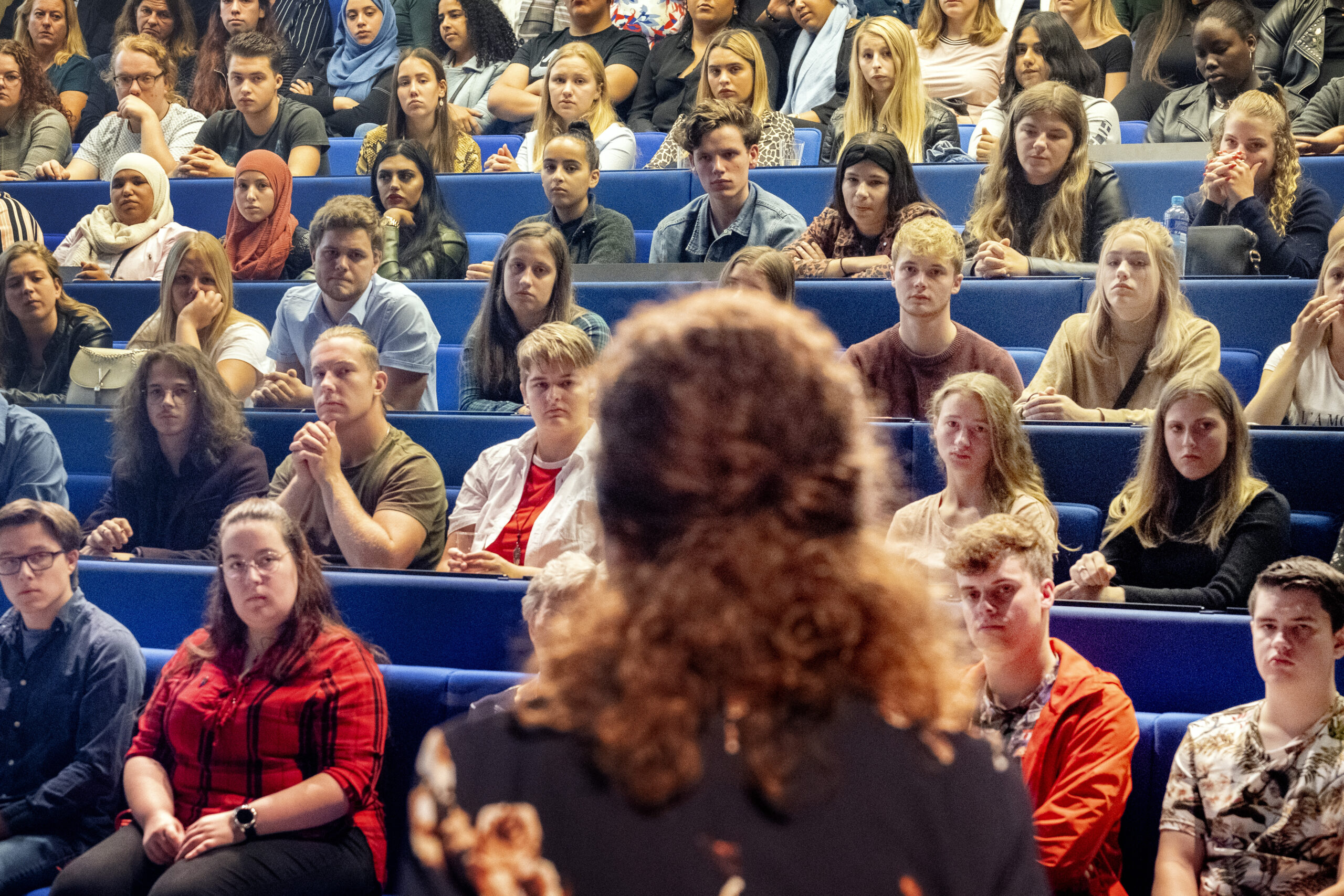
Studenten van Landstede

Nationaal Gesprek over Vrijheid x FREEDOM: Drenthe College

Mohamedou Ould Slahi heeft 14 jaar ten onrechte vastgezeten in Guantánamo Bay. Samen met De Balie en Club Guy & Roni gaat hij 15 keer met MBO-studenten door het hele land in gesprek over vrijheid en vergeving.

programmamaker en moderator
Gefinancierd door
in samenwerking met
Mohamedou Ould Slahi heeft 14 jaar ten onrechte vastgezeten in Guantánamo Bay. Samen met De Balie en Club Guy & Roni gaat hij met studenten van Drenthe College in gesprek over vrijheid en vergeving.

Vrijheid is van levensbelang. Hoe is het om van de ene op de andere dag al je vrijheid in te moeten leveren en dit pas 14 jaar later terug te krijgen?

Mohamedou Ould Slahi is sinds 2021 in Nederland. Hij regisseerde de dansvoorstelling FREEDOM, schrijft boeken en geeft lezingen over wat hij heeft meegemaakt. Wat hij het liefst doet? Met jongeren in gesprek gaan om hen te inspireren hun vrijheid op de beste manier te benutten. Daarom slaan De Balie, Club Guy & Roni en Mohamedou de handen ineen. We brengen FREEDOM naar MBO-scholen door het hele land en gaan met de studenten en Mohamedou in gesprek over vrijheid en vergeving.


Nationaal Gesprek over Vrijheid

Het Nationaal Gesprek over Vrijheid (NGOV) is een gesprek tussen studenten van het middelbaar beroepsonderwijs en bestuurlijk Nederland over burgerschap en democratie. In wat voor maatschappij willen we leven en hoe werken we hier samen naartoe?

In de lente van 2023 is er een speciale editie van het NGoV. We brengen dansvoorstelling FREEDOM van Club Guy & Roni naar MBO-scholen door het hele land en gaan met de studenten en Mohamedou Ould Slahi in gesprek over vrijheid en vergeving. Kijk op de pagina van Nationaal Gesprek over Vrijheid voor meer informatie en komende editie.

Sprekers

Mohamedou Ould SlahiSchrijver, voormalig gevangene van Guantánamo Bay
Studenten van Drenthe College

Nationaal Gesprek over Vrijheid x FREEDOM: ROC TOP

Mohamedou Ould Slahi heeft 14 jaar ten onrechte vastgezeten in Guantánamo Bay. Samen met De Balie en Club Guy & Roni gaat hij 15 keer met MBO-studenten door het hele land in gesprek over vrijheid en vergeving.

Gefinancierd door
in samenwerking met
Mohamedou Ould Slahi heeft 14 jaar ten onrechte vastgezeten in Guantánamo Bay. Samen met De Balie en Club Guy & Roni gaat hij met studenten van ROC TOP in gesprek over vrijheid en vergeving.

Vrijheid is van levensbelang. Hoe is het om van de ene op de andere dag al je vrijheid in te moeten leveren en dit pas 14 jaar later terug te krijgen?

Mohamedou Ould Slahi is sinds 2021 in Nederland. Hij regisseerde de dansvoorstelling FREEDOM, schrijft boeken en geeft lezingen over wat hij heeft meegemaakt. Wat hij het liefst doet? Met jongeren in gesprek gaan om hen te inspireren hun vrijheid op de beste manier te benutten. Daarom slaan De Balie, Club Guy & Roni en Mohamedou de handen ineen. We brengen FREEDOM naar MBO-scholen door het hele land en gaan met de studenten en Mohamedou in gesprek over vrijheid en vergeving.


Nationaal Gesprek over Vrijheid

Het Nationaal Gesprek over Vrijheid (NGOV) is een gesprek tussen studenten van het middelbaar beroepsonderwijs en bestuurlijk Nederland over burgerschap en democratie. In wat voor maatschappij willen we leven en hoe werken we hier samen naartoe?

In de lente van 2023 is er een speciale editie van het NGoV. We brengen dansvoorstelling FREEDOM van Club Guy & Roni naar MBO-scholen door het hele land en gaan met de studenten en Mohamedou Ould Slahi in gesprek over vrijheid en vergeving. Kijk op de pagina van Nationaal Gesprek over Vrijheid voor meer informatie en komende editie.

Sprekers

Mohamedou Ould SlahiSchrijver, voormalig gevangene van Guantánamo Bay
Studenten van ROC TOP

Nationaal Gesprek over Vrijheid x FREEDOM: MBO College Zuidoost

Mohamedou Ould Slahi heeft 14 jaar ten onrechte vastgezeten in Guantánamo Bay. Samen met De Balie en Club Guy & Roni gaat hij 15 keer met MBO-studenten door het hele land in gesprek over vrijheid en vergeving.

Gefinancierd door
in samenwerking met
Mohamedou Ould Slahi heeft 14 jaar ten onrechte vastgezeten in Guantánamo Bay. Samen met De Balie en Club Guy & Roni gaat hij met studenten van MBO College Zuidoost in gesprek over vrijheid en vergeving.

Vrijheid is van levensbelang. Hoe is het om van de ene op de andere dag al je vrijheid in te moeten leveren en dit pas 14 jaar later terug te krijgen?

Mohamedou Ould Slahi is sinds 2021 in Nederland. Hij regisseerde de dansvoorstelling FREEDOM, schrijft boeken en geeft lezingen over wat hij heeft meegemaakt. Wat hij het liefst doet? Met jongeren in gesprek gaan om hen te inspireren hun vrijheid op de beste manier te benutten. Daarom slaan De Balie, Club Guy & Roni en Mohamedou de handen ineen. We brengen FREEDOM naar MBO-scholen door het hele land en gaan met de studenten en Mohamedou in gesprek over vrijheid en vergeving.


Nationaal Gesprek over Vrijheid

Het Nationaal Gesprek over Vrijheid (NGOV) is een gesprek tussen studenten van het middelbaar beroepsonderwijs en bestuurlijk Nederland over burgerschap en democratie. In wat voor maatschappij willen we leven en hoe werken we hier samen naartoe?

In de lente van 2023 is er een speciale editie van het NGoV. We brengen dansvoorstelling FREEDOM van Club Guy & Roni naar MBO-scholen door het hele land en gaan met de studenten en Mohamedou Ould Slahi in gesprek over vrijheid en vergeving. Kijk op de pagina van Nationaal Gesprek over Vrijheid voor meer informatie en komende editie.

Sprekers

Mohamedou Ould SlahiSchrijver, voormalig gevangene van Guantánamo Bay
Studenten van MBO College Zuidoost

Olivia Laing: The Struggle for Bodily Freedom

Forum on European Culture

Programme editor
Rosalie Dielesen
Location & partner
‘We’re not just individuals, hungry and mortal, but also representative types, subject to expectations, demands, prohibitions and punishments that vary enormously according to the kind of body we find ourselves inhabiting. Freedom isn’t simply a matter of indulging all material cravings, Sade-style.‘ (From ‘Everybody: A book about freedom’ by Olivia Laing)

Ethnic profiling, LGBT-free zones and the undermining of abortion rights are just a few examples of recent threats to the physical integrity and safety of European citizens. But could the excluded human body be the ultimate means to resist these punitive new laws? And if so: what stops us from rising up and demonstrating for basic rights?

In ‘Everybody: A book about freedom’, Olivia Laing charts an electrifying course through the long struggle for bodily freedom, using the life of the renegade psychoanalyst Wilhelm Reich to explore gay rights and sexual liberation, feminism, and the civil rights movement.

Melyn Chow and Tea Tupajić will react tot Olivia Laings philosophy with short performances and their visions on the relationship between bodies, politics and freedom.

This programme is a cooperation between De Balie and Frascati. Tea Tupajić was produced by Frascati Producties and Melyn Chow is currently part of the production house of Frascati, Frascati Productions.

About the speakers

Olivia Laing is a widely acclaimed writer and cultural critic. She’s the author of six books, including bestsellers such as The Lonely City (2016) and Everybody: A Book about Freedom (2021). Her books have been translated into 19 languages. She writes about art and culture for The Guardian and The New York Times.

Melyn Chow is born and raised in Singapore, works in the field of Dutch mime, physical theatre, contemporary dance and performance. 

Tea Tupajić researches the role that art and performance can play in popular, often controversial social issues.

Speakers

Olivia LaingWriter and cultural critic | Photo: Sophie Davidson
Melyn chow
Melyn ChowInterdisciplinary performance maker | Photo: Eva Roefs

For Sale: European Democracy

Capital, climate and the long arm of finance

Programmamaker
Moderator
In samenwerking met
Neoliberalism has always been championed by financial elites to serve their interests. Today, however, these forces have a new face and a new strategy. A super-rich fraction of the financial sector has made a steep anti-democratic turn towards free market authoritarianism. Can we put a hold to the ongoing coup on European democracy?

In their important book, Alt-Finance, Marlène Benquet (University of Paris Dauphine) and Théo Bourgeron (University of Edinburgh) convincingly argue how the super-rich are using populist forces and nationalist sentiments to buy off democratic institutions. Following the money, the reveal the long arm of hedge funds and alternative finance and retell the histories of Brexit, Bolsonaro and Trump.

Benquet and Bourgeron provide fresh explanations for growing inequality and failing climate policies. And they present a bleak future: unless we halt the authoritarian power grab by investment capital, which is tightening its grip on Europe, we face imminent climate catastrophe. It is clear that those who care about democracy, equality, and the environment should take note and act accordingly.

More about the speakers

Théo Bourgeron is a Leverhulme Early Career Fellow at the University of Edinburgh. He has published in international journals such as Economy & Society and Organization, and is the co-editor of Accumulating Capital Today: Contemporary Strategies of Profit and Dispossessive Policies.

Johan Heilbron is a prominent sociologist and scholar known for his extensive contributions to the field of sociology of culture, economics and democracy. He has held notable academic positions at renowned institutions such as the University of Amsterdam and EHESS-CNRS in Paris.

Reijer Hendrikse is a financial geographer, political economist and postdoctoral researcher at the Vrije Universiteit Brussel (VUB). In his research, Reijer has explored the ‘long arm of finance’, the financialisation of governments and the historical origins of the integrated European financial space.

Sprekers

Théo BourgeronSociologist, author of Geldschieters
Reijer HendrikseFinancial geographer, Vrije Universiteit Brussel
Johan HeilbronSociologist, professor at Uppsala University, Erasmus University, EHESS Paris.

More?

Video

Paradigma: Marcuse en de eendimensionale mens

Kijk terug
Video

George Monbiot: Regenesis Feeding the world without devouring the planet

Kijk terug

Shostakovich: Art under Authoritarianism

Programme Editor
Making art under the threat of a dictator, confronts the artist with many practical and moral dilemma’s. Is it even possible to work as an artist under autocratic rule? Can culture be seperated from social and political developements? In this programme we discuss this topic by focusing on the Russian composer Dmitri Shostakovich who created his music under Stalin’s dictatorship. With Maxim Osipov, the Eliot Quartet, musicologist Saskia Törnqvist and Shostakovich’ expert Lev Akopian, working in Moscow and an outspoken critic of Putin’s regime.

Dmitri Shostakovich, one of the greatest composers of the 20th century, lived during the Sovjet-era and the Second World War. Although he was initially celebrated by the Soviet government as a symbol of Soviet culture, he fell out-  and back into of favor multiple times and faced intense pressure and censorship from the Soviet authorities. 1936 marked the beginning of the Great Terror, in which many of Shostakovich’s friends and relatives were imprisoned or killed.

His life and work demonstrate the complex and fraught relationship between artists and political authority in a totalitarian society. Lev Akopian will guide us through his work, the Eliot Quartet will engage in his lecture by playing examples and the evening will end with a concert. 

About the speakers

Saskia Törnqvist is a musicologist, publicist, and teacher. She graduated in 1995 at the University of Amsterdam with a research into the Dutch reception of the work of Dmitri Shostakovich. In this programme, she will share her findings about the Dutch reception of his work.

Lev Akopyian is Doctor of Art Criticism. Born in 1953 in Yerevan, Armenia; graduated from Yerevan State University and Komitas Yerevan State Conservatory. Current positions: Head of the Music Theory Department at the Russian State Institute for Art Studies, edi­tor of the electronic peer-reviewed journal “Art of Music: Theory and History,” member of the editorial staff of the New Collected Works by Dmitry Shostakovich.

The Eliot Quartett was founded in 2014 and has become one of the most engaging and promising string quartets of the next generation. Hailing from Canada, Germany and Russia, the quartet’s members formed the group in Frankfurt am Main and have since gone on to win prizes at major national and international music competitions.

Speakers

Maxim Osipov De Balie
Maxim OsipovWriter in exile
Lev AkopianDoctor of Art Criticism
The Eliot Quartett
Saskia TörnqvistMusicologist, publicist, teacher.
Sjeng ScheijenModerator
Image: Marit Breuker
The Eliot Quartett

How Europe Says sorry

Forum on European Culture

Programme Editor
Last December, Dutch prime-minister Mark Rutte formally apologized for the colonial past of The Netherlands, after years of grappling with the colonial legacy. He acknowledged the damage our state has done to enslaved people for hundreds of years and the effects this still has. Is apologizing the right approach to take and if so, what is the right way to apologize? With leading thinkers from different European countries, we’ll discuss how we should deal with the crimes of Europe’s colonial past.

Germany was the first European country to apologize in 2001. The United Kingdom has expressed regret, but hasn’t apologized yet. However, English cities London and Liverpool have uttered their apologies. And while in France the government has long acknowledged their actions as a crime against humanity, in Spain and Portugal the discussion about the colonial past has hardly come off the ground.

Are formal apologies sufficient to close the book on colonialism? Or are reparations in order? Our experts will draw on their expertise to help us answer these difficult questions our shared European colonial legacy poses and, how the colonial past and present of former imperial powers differ from each other.

About the speakers

Mame-Fatou Niang is a scholar, writer, filmmaker and racial justice activist. Niang is an Associate Professor of French & Black Geographies and the founder/director of Center for Black European Studies and the Atlantic. She wrote two books in which she discusses the notion of the French identity: Universalisme (2022) and Identités Françaises: Banlieues, Féminités et Universalisme (2019).

Kehinde Andrews is an academic and author of British African-Caribbean heritage. Andrews is UK’s first Professor of Black Studies at Birmingham City University. He regularly appears in the media discussing issues of race and racism, colonialism and slavery, and British nationalism.

He is a frequent contributor to British media outlets as The Guardian, the BBC and Good Morning Britain. Furthermore, he wrote multiple books on race and colonialism, like The New Age of Empire (2021). Andrews is the director of the Centre for Critical Social Research, founder of the Harambee Organization of Black Unity, and co-chair of the UK Black Studies Association.

Sofia Lovegrove is an independent researcher and heritage professional born in the UK, brought up in Portugal and based in the Netherlands. Her research lies at the intersection of critical heritage and memory studies, with a focus on (re)presentation of the Portuguese and Dutch colonial pasts and their afterlives in museums, heritage sites and public memory. She currently works at the Cultural Heritage Agency of the Netherlands (Ministry of Education, Culture and Science) where she focuses on the topics of multiperspectivity, inclusion, the slavery and colonial past and international heritage cooperation.

Wouter Veraart (1971) is Professor of Legal Philosophy and head of the Department of Legal Theory and Legal History at the Vrije Universiteit Amsterdam. Veraart has a strong interest in questions of historic injustice, restitution, victimization and the rule of law. Since 2021, he is one of the investigators of the research program Pressing Matter, which deals with the provenance and destination of colonial collections in Dutch museums. Veraart’s publications include articles on the value of apologies and reparations in relation to slavery and other forms of colonial injustice, most recently “Apologies from the heart: Some reflections on national apologies for colonial slavery” (in Dutch) in Tijdschrift voor Herstelrecht (2022).

Website Pressing Matter: https://pressingmatter.nl/

Speakers

Mame-Fatou NiangScholar, writer, filmmaker and racial justice activist (FR)
Kehinde AndrewsAcademic and author (UK)
Sofia LovegroveIndependent researcher (PT/UK/NL)
Wouter VeraartProfessor of Legal Philosophy (NL)

Forum on European Culture:

za 3 jun / 20:00
Politiek & Democratie

Ece Temelkuran: The Dilemma of Climate Democracy

Can we save the planet without breaking the democratic system? A conversation with Ece Temelkuran, Eva Rovers and Clare Farrell (XR).

Meer Info Tickets
za 3 jun / 20:30
Idee & Verbeelding

Theatre of War: The Persians

Listen to The Persians, the first theatre play in European history. A 2500-year-old text by Aeschylus about an imperialistic king trying to crush Greek democracies. Performed by actors

Meer Info Tickets
vr 2 jun / 20:30
Politiek & Democratie

CANCELLED Eline Arbo & Natalie Haynes on European Tragedy

Can we draw moral lessons from ancient European myths? And how do we deal with their predominantly male perspective?

Meer Info Tickets

Theatre of War: The Persians

Forum on European Culture

Programme Editor
Text
Hans Croiset (based on Aeschylus)
Produced and directed by
Yoeri Albrecht, Merlijn Geurts (De Balie)
Language
Dutch (English subtitles)

Listen to The Persians, the first theatre play in European history. A 2500-year-old text by Aeschylus about an imperialistic king trying to crush Greek democracies. Performed by actors Victoria Koblenko, Gijs Scholten van Aschat, Janni Goslinga and Hans Croiset.

The Persian court is awaiting news from their army. Under the leadership of emperor Xerxes, the country’s military troops left Persia to fight a battle at sea. They receive the worst possible news: their entire fleet is crushed by the much smaller Greek forces.

The ancient writer Aeschylus, who served as a soldier in the Greek army against the invading Persians, decided not to glorify the Greeks’ military might, but attempted to give words to the perspective of the defeated enemy. To what extent are these 2500-year-old words recognizable to those who are experiencing the reality of today’s brutal war? After the performance, we invite people from the audience to reflect on what Aeschylus’ text tells us today.

Nederlandse tekst

Luister naar De Perzen, het eerste toneelstuk in de Europese geschiedenis. Een 2500 jaar oude tekst van Aeschylus over een imperialistische koning die de Griekse democratieën probeert te verpletteren. Uitgevoerd door acteurs Victoria Koblenko, Gijs Scholten van Aschat, Janni Goslinga en Hans Croiset.

Het Perzische hof wacht op nieuws van hun leger. Onder leiding van keizer Xerxes hebben de militaire troepen van het land Perzië verlaten om een strijd op zee uit te vechten. Ze krijgen het slechtst mogelijke nieuws: hun hele vloot wordt verpletterd door de veel kleinere Griekse troepen.

De antieke schrijver Aeschylus, die als soldaat in het Griekse leger tegen de binnenvallende Perzen diende, besloot de militaire macht van de Grieken niet te verheerlijken, maar probeerde het perspectief van de verslagen vijand onder woorden te brengen. In hoeverre zijn deze 2500 jaar oude woorden herkenbaar voor hen die de realiteit van de huidige brute oorlog ervaren? Na de voorstelling nodigen we mensen uit het publiek uit om na te denken over wat Aeschylus’ tekst ons vandaag vertelt.

Cast

Victoria Koblenko in De Balie
Victoria KoblenkoActor, activist
Gijs Scholten van AschatActor | Photo: Huib van Wersch
Janni Goslinga Actor | Photo: Jan Verweysveld

Music

Ata GünerMusician and composer
This programme will not be livestreamed.

Forum on European Culture:

zo 4 jun / 13:30
Politiek & Democratie

Simon Schama: What History Teaches Us About Pandemics

How should we look back on the way we dealt with COVID-19? And how can societies prepare themselves for new viruses to come?

Meer Info Tickets
za 3 jun
Cinema

The Killing of a Journalist

How is it that journalists are not safe within the European Union, and how is it possible that such misconduct can happen in our common space?

Meer Info Tickets
vr 2 jun / 20:00
Politiek & Democratie

European Literature Night 2023: Between Utopia and Dystopia

Ten European writers get together to reflect on the utopian and dystopian mirrors of current society.

Meer Info Tickets

Ece Temelkuran: The Dilemma of Climate Democracy

Forum on European Culture

programme editor
Rosalie Dielesen
Mdoerator
In Cooperation with
DutchCulture
Climate change is a European reality. Ece Temelkuran is a prominent Turkish journalist, author, and political commentator on climate change and its impact on societies around the world. In her writings and speeches, Temelkuran emphasizes the urgent need for global action to address this existential threat to humanity. She will be discussing the dilemma of climate democracy with writer Eva Rovers and Clare Farrell, co-founder of Extinction Rebellion.

Europe has set ambitious climate targets, including reaching net-zero greenhouse gas emissions by 2050 and reducing emissions by at least 55% by 2030 relative to 1990 levels. In any event, the question remains whether these targets will be met in time to mitigate the impacts of climate change.

While some propose new institutional forms of public consultation to circumvent political inactivity, others believe it is necessary to act more quickly. During this programme, the following question will be examined: can we save the planet without breaking the political system?

Programme setup

Loes Damhof will guide the audience through an interactive thought experiment. Based on the principles of Futures Literacy – a capability developed by UNESCO – the audience and panellist will explore multiple futures and identify their assumptions on democracy and agency.

Reframed based on those assumptions, they are invited to view the debate through a different lens. What does agency mean, when do we question our assumptions? This quick democratic flex is followed by Ece Temelkuran’s keynote address, plus a panel discussion with Eva Rovers and Clare Farell.

About the speakers

Ece Temelkuran is a prominent Turkish journalist, author, and political commentator known for her critical perspective on the politics of Turkey and the wider Middle East region. Temelkuran has been an active commentator on climate change and its impact on societies around the world. In her writings and speeches, she emphasizes the urgent need for global action to address this existential threat to humanity.

Eva Rovers is a Dutch writer and cultural historian. She is also the co-founder of Bureau Burgerberaad. In her most recent book ‘Nu is het aan ons’ – Oproep tot echte democratie” (“Now it’s up to us. Call for real democracy”), she passionately argues for not leaving politics exclusively to politicians. The multifaceted problems of the 21st century require a multifaceted approach, and citizen assemblies are ideal for that.

Clare Farrell is an active citizen, devoting her creativity, her energy, and occasionally her personal liberty, to fight against climate collapse and the wider environmental crisis. As one of the cofounders of Extinction Rebellion her work to date has included coordinating the creative team that delivered the name, identity, and messaging that the movement set out with in 2018, co-editing the bestselling book, This is Not a Drill, and now works with the UK media team and acts as a spokesperson.

Loes Damhof was elected as Lecturer of the Year of all higher education in The Netherlands in 2016, and decided to use the Comenius Grant to further advance the skill of Futures Literacy. In short terms, training Futures Literacy invites us to use different conceptions and ideas about the future as lenses for interpreting, understanding and seeing anew our world and ourselves in it in the present. In 2018, Loes received the UNESCO Chair on Futures Literacy in Higher Education at Hanze University of Applied Sciences.

Loes Damhof

In addition to her research and teaching practices, Loes consults and trains staff of global organizations such as FutureWomenX, UNESCO, UNFCCC, ClimateKIC,  Copenhagen Institute for Futures Studies and Oxfam. Over the years, Loes and her team have set the golden standard for training and teaching Futures Literacy. Currently she is building The Emergence Academy; new school for new activism, that fosters a new attitude towards complexity, uncertainty applied to wide range of societal domains.

Speakers

Ece TemelkuranJournalist, author and political commentator | Photo: De Balie / Jan Boeve
Eva RoversWriter and cultural historian | Photo: Frank Ruiter
Clare FarrellCofounder Extinction Rebellion
Loes Damhof
Loes DamhofExpert Futures Literacy (Foto: Wouter Brem)
Image: Marit Breuker

Forum on European Culture:

zo 4 jun / 13:30
Politiek & Democratie

Simon Schama: What History Teaches Us About Pandemics

How should we look back on the way we dealt with COVID-19? And how can societies prepare themselves for new viruses to come?

Meer Info Tickets
vr 2 jun / 20:30
Politiek & Democratie

CANCELLED Eline Arbo & Natalie Haynes on European Tragedy

Can we draw moral lessons from ancient European myths? And how do we deal with their predominantly male perspective?

Meer Info Tickets
zo 4 jun
Cinema

The Lost Leonardo

The Lost Leonardo is a fascinating story about the most expensive painting ever sold. A revealing and exciting film about the world of the art trade and the hidden interests of…

Meer Info Tickets